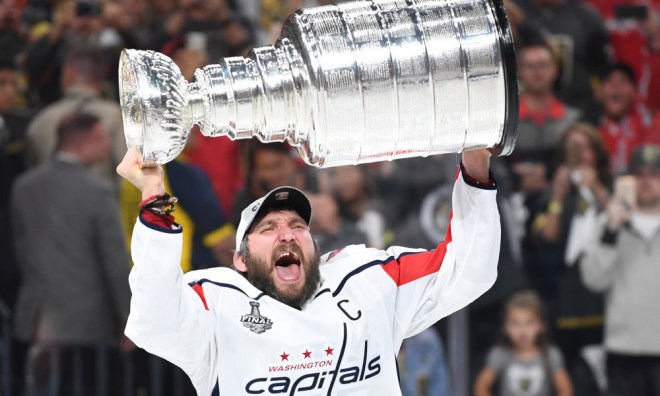
There is no question about it: Washington Capitals captain Alexander Ovechkin is one of the greatest hockey players and athletes in the history of sports. Period.
Picked first overall in the 2004 NHL Draft, he has spent a fifteen-year career striking fear in the hearts of NHL goaltenders and defensemen and striking pucks in the back of the net. This year, we witnessed the Great 8 rise to become one of the top three NHL goal scorers ever, and he stands alone as the all-time leader in NHL goals and points by a Russian-born player. He has hit for 50 or more goals in a season 6 times, has more overtime goals in his career than any other player, has hit for at least 30 goals in every season he’s played—a record reached only by the likes of former Caps Jaromir Jagr and Mike Gartner–and has won the NHL scoring title eight times.
In addition to the Stanley Cup, OV’s hardware includes the Conn Smythe Trophy as the Stanley Cup Playoff MVP (2018), the Prince of Wales Trophy as the Eastern Conference playoff champions (2018), the Hart Memorial Trophy as the league MVP (2008, 2009, 2013), the Art Ross Trophy as the league’s top scorer (2008), and the Calder Memorial Trophy as the leagues top rookie (2006), among numerous other awards and honors.
He is still only 36 years old.
Starting as a 20-year-old, this stands as a tremendous testament to his drive, work ethic, and overall pure talent as a hockey player and an athlete. But one thing about his illustrious journey, I think, truly stands out above all else.
He is a millennial, and he has done all this under the employment of one organization.
Whether you’re a Russian slap-shooting titan or a skinny blue-eyed American writer, your age and status as a millennial (or a part of the generations that followed) is, to the world, a stain; a stigma; a stereotype that has citizens and employers of previous generations cautious of employing you. A simple, incomplete Google search tells you everything about what the world thinks of millennials.
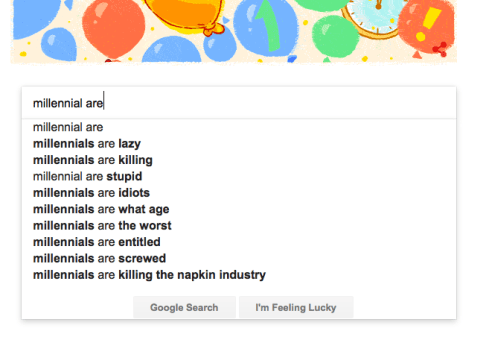
In addition to killing the napkin industry–somehow–millennials face a greater challenge in proving their greatness above the stereotypes that the workforce has placed on them: that millennials are unsatisfied with work, don’t know how to work (bad work ethic), or simply don’t follow orders or directives at work.
Of course, these and most of the other stereotypes are false. But rather than dive into why they are false and what companies and older generations should do to get the most out of millennials, I would rather chase curiosity and consider how the Washington Capitals–a team and city where hopes and dreams so sports glory have a history of dying prematurely–have kept the greatest Russian player in D.C. for so long.
The team invested in their captain
Leonsis vividly remembers a phone call he received back in 2018 from then-NBA commissioner David Stern.
The call came following the announcement that Leonsis signed Ovechkin to a 13-year, $124 million contract extension, a deal that’s not even possible in the NHL today because the collective bargaining agreement doesn’t allow contracts longer than eight years. Stern’s main concern with the extension was how Ovechkin would stay motivated with that kind of guaranteed-contract security. No doubt the question loomed on Leonsis’s mind too,
But he kept his faith in the franchise-changing winger, knowing that time will tell. As a result, Leonsis and Ovechkin have made the D.C. area one huge, tri-state hockey town, and the Washington Capitals have gone from a moderate team in the NHL to the mainstream club in the area and the league.
“I think [the contract] gives permission for the fans to say, ‘We deserve this, and he’s not going anywhere,’ ” Leonsis said. “That to me was the most important thing, that we were accustomed as a community — we weren’t a hockey market at the time — and it was always, ‘We’ll lose our best players.’ And when Alex said, ‘No, this is where I want to be, and I’ll make a long-term commitment,’ I think it really was the tipping point for the organization, for the fan base to say we’ve got something here and he’s delivered in every way.”
The club, and Leonsis in particular, have had the privilege of witnessing their faith being rewarded and their “stupidest decision” payoff year after year. Their investment has also made them truly blessed by allowing them to witness the growth of their captain not only as a superstar employee, but as a person who came to the U.S. from Russia at age 20.
“I’m really proud of him,” Leonisis said. “He has become a real, fully developed human. He has a family, he is a husband and a dad. He is still funny and charming, but he is much more mature.”
“Do I have any regrets? Yeah, my regret is it wasn’t a 15-year contract,” Leonsis said.
Capitals owner Ted Leonsis also expects Ovechkin to finish his career in Washington.
“Alex is a very, very loyal person, and we want to create something where we’re in it together,” he said. “Alex and I have spoken often about his career arc and the narrative and both those players (Ovechkin and Niklas Backstrom) have said they want to be different, they want to finish what they started, and they would like to be in this community for their entire careers. So we’ll work on that.”
Ovechkin–the Millennial–focused and worked
Professional sports is arguably the most challenging industry to break into, especially if you’re an aspiring athlete. Watch any interview or read any biography of your favorite athlete, and you’ll find that to make it in the pros, let alone become one of the greats, requires strict discipline, an unbreakable work ethic, and tremendous sacrifice.
Let’s consider some examples:
- Basketball great Kobe Bryant would be found on the court several hours before anyone else arrived for practice, even as early as 4 A.M.! The result, of course, was becoming one of the greatest players in NBA history, winning multiple championships with the L.A. Lakers.
- Portuguese soccer maestro Cristiano Ronaldo lives by the mantra “first to arrive, last to leave”, even as a young star at Manchester United. The man known as CR7 continues his meticulous approach to perfecting himself and his craft even today and, at age 37, is on pace to return to the FIFA World Cup this winter for the fourth time. “Everything he does, he does carefully and tailored to his daily goals. You will never see him do anything on a whim,” said Juventus central defender and captain Giorgio Chiellini, who was Ronaldo’s teammate from 2018-2021. “At 34, you see in him his desire to improve and you feel the need to learn something from him. He’s like a hyena on the pitch. The only thing you have to do is make him feel comfortable.”
Ovechkin is no different. Despite his natural gift for the great game of hockey, the Great 8 was determined to be the best and to keep on improving his game and his persona both on and off the ice.
“I’ve never made it a secret of how I want to be the best player in the world,” he said in an interview with Trans World Sport back in 2004–when he was just 18. “I’m going to do my best and then some to make that dream come true.”
I’ve already stated how we’ve seen the brilliance spawned from this determination to be the best. But when the world economy virtually shutdown and professional sports were suspended, OV’s determination to maintain form was made clear through news and social media, where he’s been seen training on vacant high school sporting grounds, in his backyard with fellow Russian Cap Evgeni Kuznetsov, or in his gym at home under the guidance of the most effective trainer of all: his one-year-old son, Sergei.
Ovechkin and the DC/MD/VA region fell in love
“Of course I would love to stay in Washington,” Ovechkin said when asked about his contract with the team, “I said I don’t want to play for a different team than Washington.”
As a sports fan in D.C., where competing for a league championship is always a dream rarely fulfilled, hearing one of the greatest athletes in the world proclaim such is as touching and groundbreaking as forgiving the assassin who tried to murder you in Vatican City.
From the day he was drafted as 20-year-old kid to the day he finally lifted the Stanley Cup, the entire D.C. region and beyond has welcomed the Russian star with open arms and big smiles, and he has reciprocated that love for the people and players he works with and with citizens of D.C. through his work on and off the ice these last 17+ years, from lifting the cup to bumping shoulders and going bowling with the fans.
He did so much, and not once has the entire D.C. region faltered in their love and support of their captain.
What can millennials and younger generations learn, and what can older gens learn about millennials?
There are three things that we should be taking away from the romance of Alex Ovechkin and the Washington Capitals family:
- Like Leonsis, who took a risk and signed his young star for the largest contract allowed, employers are always taking a risk when recruiting new employees, especially younger workers.
- Ovechkin worked endlessly to get to where he’s at now and continues to work endlessly. Everyone, no matter what generation, needs to work to be the best for the company if they are to stay.
- Beyond financial compensation is the Washington Capitals/D.C. sports culture that embraced Ovechkin from the day he was drafted. It’s a love that has influenced Ovechkin’s desire to stay in the nation’s capital for the duration of his career. That same relational culture should be practiced within a business. The culture within a company can either make or break an employee’s desire to remain and can significantly influence productivity throughout. It is a two-way relationship where both parties not only provide incentives and expectations, but are also able to embrace each other on a holistic level and truly be proud to be a part of the same team together.
Featured Image source: For the Win (https://ftw.usatoday.com/2018/06/watch-alex-ovechkin-lift-the-stanley-cup-after-13-year-wait)
 Eric Kambach